
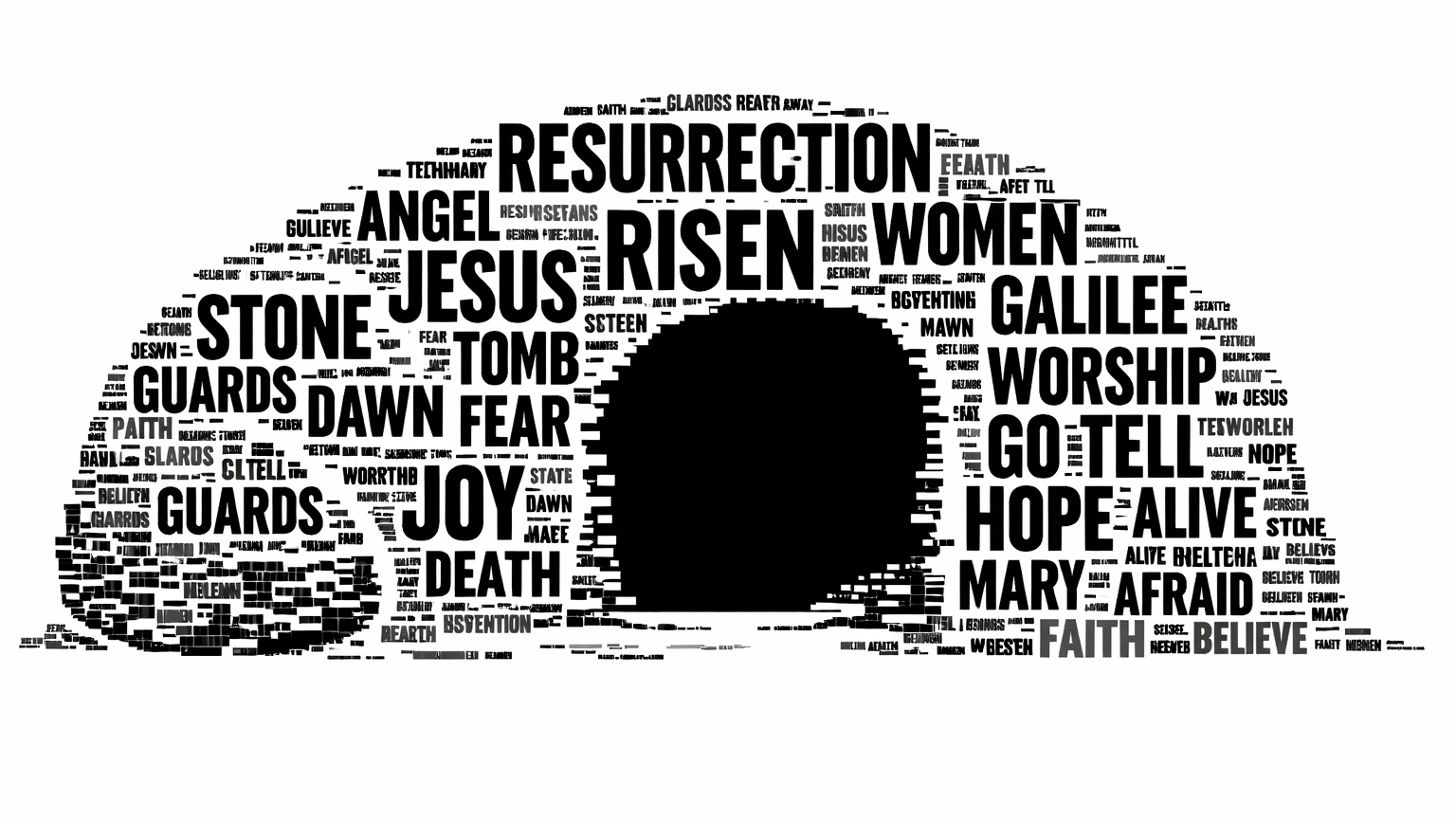
Matthew 28:1–10 speaks into the kind of morning that feels impossible. The cross has done its worst. Jesus has been executed, buried, and sealed behind stone and guard. The disciples are scattered. The women come to the tomb carrying grief, not hope. They aren’t expecting resurrection. They’re expecting death to stay where it was left. That matters, because Matthew doesn’t present Easter as wishful thinking or religious optimism. He presents it as God acting in the middle of human sorrow, fear, and apparent defeat.
Matthew tells us the women come “after the Sabbath, at dawn on the first day of the week.” That detail does more than mark time. Dawn becomes a fitting setting for what God is doing. A long night is ending. What seemed closed is opening. What looked final is being overturned. Matthew’s Gospel has shown Jesus as Emmanuel, God with us, from the beginning. Now at the resurrection, that promise is not cancelled by suffering or death. It’s confirmed. The crucified Jesus is alive, and God’s saving purpose has not failed (France).
The women, Mary Magdalene and “the other Mary,” become the first witnesses to the empty tomb. In a world where women were often not treated as reliable public witnesses, Matthew places them at the center of the resurrection account. That is not accidental. God again works through those the world is likely to discount. The risen Christ is first announced not in the temple courts or before political power, but to faithful women who came in love and grief. Grace often breaks in through people others overlook (Keener).
This passage also shows that resurrection faith is not vague spirituality. Matthew anchors it in concrete events, a specific tomb, a stone, frightened guards, an angelic announcement, and a risen Jesus who meets His followers on the road. The resurrection is not presented as an inner feeling that Jesus lives on in memory. It is announced as an act of God in history. Because Jesus is raised, fear is challenged, worship is invited, and mission begins to move forward again (Davies and Allison).
Origin and Name
The Gospel takes its name from Matthew, also called Levi, the tax collector whom Jesus called into discipleship. That detail still matters because Matthew’s own story reflects the grace of Christ. A man many would have dismissed becomes the one whose Gospel shows again and again that Jesus is the fulfillment of Israel’s hope and the Savior who welcomes the outsider (France).
Authorship
Early church tradition identifies Matthew as the author of this Gospel. While scholars discuss how the Gospel was composed and what sources may have been used, the text itself carries a distinctly Jewish texture, deep familiarity with Scripture, and a strong concern to show that Jesus fulfills the story of Israel. Its theological voice is careful, structured, and pastoral, helping the church understand who Jesus is and what faithful discipleship looks like (Keener).
Date and Setting
Matthew was likely written between AD 70 and 90, after the destruction of the Jerusalem temple. That was a painful and disorienting period for Jewish communities and for Jewish Christians. Questions about identity, authority, and the future were pressing. Matthew writes into that setting by presenting Jesus as the true Messiah, the one in whom God’s purposes have not failed but have come to fulfillment (Davies and Allison).
Purpose and Themes
Matthew presents Jesus as the promised Messiah, the Son of David, the new Moses, and the one who brings the kingdom of heaven near. Major themes include fulfillment of Scripture, discipleship, righteousness, judgment, mercy, and the widening reach of God’s saving work.
Structure
The Gospel combines narrative and teaching, moving through key scenes in Jesus’ life and ministry and arranging much of His teaching into five major discourse sections. This pattern gives the book both story and instruction.
Significance
Matthew stands as a bridge between the Old Testament and the New. It shows that Jesus does not discard God’s promises to Israel but fulfills them, deepens them, and carries them forward.
Matthew 28:1–10 comes after betrayal, trial, crucifixion, and burial. The powers of religion and empire have done what they can. The tomb was sealed at the end of chapter 27, and guards were posted to prevent interference. Human authority has tried to shut the matter down. Then chapter 28 opens with God overturning every human claim to finality. The resurrection is Matthew’s answer to the question hanging over the passion story: Has evil won? Matthew’s answer is no. God has vindicated Jesus.
Within Matthew’s Gospel, this passage completes what has been building from the start. Jesus is called Emmanuel in chapter 1. He is worshiped by the magi in chapter 2. He teaches with authority, forgives sins, calms storms, confronts demons, and speaks openly about His coming death and resurrection. The resurrection does not appear out of nowhere. It is the vindication of who Jesus has been all along (Wright).
Within the wider biblical story, this passage marks the beginning of new creation. The first day of the week echoes Genesis language. The God who once brought life out of the void now brings life out of the grave. Death entered the human story through sin, but here death is broken by the risen Christ. The promises of the prophets, the hopes of Israel, and the need of all humanity meet at this empty tomb. Easter is not one inspiring episode. It is the turning point of the whole redemptive story (Nolland).
John Wesley would have seen in this passage the triumph of God’s grace over every power that holds humanity in bondage. Sin, death, fear, and the devil do not have the last word. The resurrection is not only proof that Jesus lives. It is the declaration that God’s saving work is stronger than the powers that destroy human life. That fits deeply with Wesley’s emphasis on grace as active, restoring, and victorious.
Wesley also stressed that grace is not abstract. It reaches people where they are. In Matthew 28, the women come grieving, fearful, and uncertain. They don’t arrive with polished faith. They arrive carrying sorrow. Yet God meets them there. The angel speaks comfort before command, “Do not be afraid.” Then the risen Jesus meets them personally. That movement is important. Grace addresses fear, then invites response. God does not wait for perfect faith before He comes near (Collins).
From a Wesleyan perspective, this passage also points toward living faith. The women do not simply receive information. They move. They leave the tomb, they run, they tell, and when Jesus meets them, they worship Him. Grace awakens, but it also sends. Resurrection faith is not passive agreement. It becomes witness, obedience, and holy love in action. Easter does not merely comfort the heart. It redirects the life.
Matthew 28:1–4, The Tomb Is Opened by the Power of God
Matthew begins “after the Sabbath, at dawn on the first day of the week.” The Sabbath has ended, and a new week begins. That timing matters. The resurrection is tied to the language of beginning. Matthew wants us to see not only that Jesus is alive, but that something new has started. The women come “to look at the tomb.” Matthew does not say they came expecting resurrection. They come as mourners. Their faithfulness is real, but so is their grief.
Then the scene is interrupted by a “violent earthquake,” because an angel of the Lord descends, rolls back the stone, and sits on it. The stone is not moved so Jesus can get out, as though He were trapped until heaven arrived. It is moved so the women and later others can see that the tomb is empty. The angel sitting on the stone signals triumph, not urgency. What humans sealed, God undoes with ease (France).
The angel’s appearance is described in dazzling terms, like lightning and white as snow. Matthew uses imagery that communicates heavenly authority and holiness. The guards shake and become “like dead men.” That reversal is striking. The men assigned to guard the dead appear dead themselves, while the one they were meant to contain is alive. Matthew is showing the weakness of human power before the action of God. Rome can post guards. Religious leaders can seal a tomb. None of it can stop resurrection (Keener).
Matthew 28:5–7, Fear Is Met with Good News
The angel speaks first to the women, “Do not be afraid.” That is one of the most important lines in the passage. Fear is real in this scene. The guards are terrified. The women are shaken. The world has become unstable. But heaven’s word is not condemnation. It is comfort. The women are told not to be afraid because the one they seek, “Jesus, who was crucified,” is not there. Matthew keeps the cross and resurrection together. The risen one is the crucified one. Easter does not erase Good Friday. It reveals that Good Friday was not the end (Davies and Allison).
The angel says, “He has risen, just as he said.” That phrase points back to Jesus’ own predictions. The resurrection confirms Jesus’ reliability. He is not only alive, He is true. His words can be trusted. Matthew’s Gospel has repeatedly asked whether people will listen to Jesus. Here the resurrection declares that every word He spoke stands firm (Nolland).
The women are invited, “Come and see the place where he lay.” Christian faith is not asked to leap away from evidence. The women are called to look. Then they are told, “Go quickly and tell his disciples.” There is a pattern here, come and see, then go and tell. Encounter leads to witness. The message also includes Galilee. Jesus will go ahead of them there. That matters because Galilee is where so much of the ministry began. It is also away from the center of power. The risen Christ gathers His people not around the structures that condemned Him, but in the place where discipleship first took root (Wright).
Matthew 28:8–10, Fear and Joy Become Worship and Witness
The women leave “afraid yet filled with joy.” Matthew does not flatten resurrection response into one emotion. Their fear has not vanished all at once, but joy now lives alongside it. That feels true to life. When God acts in a way that changes everything, people may feel stunned before they feel steady. Resurrection does not always begin in composure. Sometimes it begins in trembling joy.
Then Jesus Himself meets them. Matthew is brief, but the moment is powerful. Jesus says, “Greetings.” The ordinary word becomes extraordinary because of who is speaking. The women come to Him, clasp His feet, and worship Him. This is a bodily resurrection scene. They touch Him. He is not a ghost, not a memory, not merely symbolic presence. Matthew gives a concrete picture of the risen Christ receiving worship (Keener).
Jesus repeats the angel’s word, “Do not be afraid.” That repetition matters. The risen Lord addresses fear Himself. He then sends them to tell His “brothers” to go to Galilee. That word, brothers, carries grace. These are the disciples who fled, denied, and failed. Yet Jesus does not cast them off. Resurrection includes restoration. The risen Christ gathers failed disciples back into relationship and mission. That is good news for every believer who has ever faltered. Easter does not just announce that Jesus lives. It announces that Jesus still calls, still forgives, and still gathers His people (France).
This passage matters apologetically because Matthew presents the resurrection as a public claim rooted in events, not a private mystical idea. There is a known tomb, named witnesses, frightened guards, and a message that leads to further appearances. The women are not described as primed to invent resurrection. They come expecting death. That actually strengthens the credibility of the account. The resurrection is not born from wish fulfillment. It breaks in against expectation.
The passage also pushes against the idea that resurrection was only symbolic. Matthew shows bodily reality. The stone is moved, the tomb is empty, and the women take hold of Jesus’ feet. The claim is not merely that Jesus’ teachings live on or that His spirit inspires people. The claim is that God raised Him from the dead. Christianity stands or falls on that kind of claim, not on vague encouragement.
Philosophically, this passage speaks to one of the deepest human fears, that death is final and meaning is fragile. Matthew answers that fear not with sentiment but with resurrection. If Christ is raised, then evil is not ultimate, suffering is not ultimate, and death is not ultimate. Hope is not self-generated optimism. It is grounded in what God has done in Christ.
A lot of people know what it is to stand in the aftermath of something painful and wonder what now. A death. A betrayal. A diagnosis. A broken plan. A season where what you counted on feels sealed behind stone. Matthew 28:1–10 reminds us that God still works where we assume the story is over.
The women came to the tomb carrying grief, and they were met by the living Christ. That doesn’t mean grief is fake or pain is small. It means pain doesn’t get the final word. Resurrection says God can meet us in the place we feared most and speak a future we could not imagine on our own.
This passage also reminds us that fear and faith can exist in the same person at the same time. The women were afraid and full of joy. They were shaken and still moving. That is comforting, because many of us think faith means never trembling. It doesn’t. Sometimes faith looks like carrying your fear while still obeying Jesus.
And there’s one more thing here we shouldn’t miss. The risen Jesus sends the women to tell others. Easter people don’t stay frozen at the tomb. We go. We tell. We worship. We live like death has been defeated because in Christ it has. That doesn’t remove every hard thing from life, but it changes what hard things can finally do to us.
Psalm 16:10
Isaiah 25:8
Hosea 6:2
Matthew 16:21
Matthew 27:62–66
Luke 24:1–12
John 20:11–18
1 Corinthians 15:20–22
Hebrews 2:14–15
Revelation 1:17–18
